

Mr damage, p.1
Mr Damage, page 1


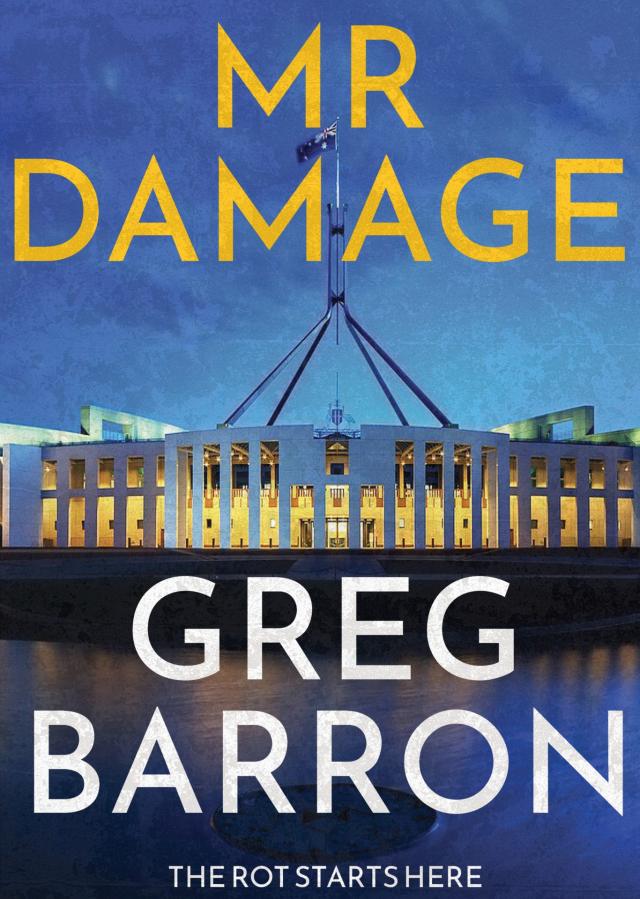
Gwen McRae is a mid-level analyst at the Department of Home Affairs. After stumbling on an intercepted conversation between members of a Hong Kong triad, incriminating an Australian government minister, she is suspended from her job and isolated from the man she loves.
Clancy Gage, from Katherine, Northern Territory, is a small-time miner with big dreams. When his brother Shane disappears from their exploration lease, Clancy is drawn into a deadly search that will take him close to the edge.
From Canberra and the Northern Territory to the Timor Sea, Clancy and Gwen join forces, gathering a cast of colourful allies, heading into hostile territory where loaded guns and big money rules.
Together, Clancy and Gwen must confront the troubled figure at the core of the conspiracy – the mystery figure who calls himself Mr Damage.
Also by Greg Barron
HarperCollins Publishers Australia
Rotten Gods
Savage Tide
Lethal Sky
Voodoo Dawn (short fiction)
Stories of Oz Publishing
The Hammer of Ramenskoye (short fiction)
Camp Leichhardt
Galloping Jones and Other True Stories from Australia’s History
Whistler’s Bones
Red Jack and the Ragged Thirteen
Outlaw: The Story of Joe Flick
The Time of Thunder
The Last Days of Dom Sebastian
The Pedestrian
Wild Dog River
For younger readers:
High Country Caper
Gulf Country Gambit
Mr Damage
by
Greg Barron
First edition published 2025
by Stories of Oz Publishing
PO Box K57
Haymarket NSW 1240
ABN: 0920230558
facebook.com/storiesofoz
ozbookstore.com
The right of Greg Barron to be identified as the author of this work has been asserted by him in accordance with the Copyright Amendment (Moral Rights) Act 2000
This work is copyright. Apart from any use as permitted under the Copyright Act 1968, no part may be reproduced, copied, scanned, stored in a retrieval system, recorded, or transmitted, in any form or by any means, without the prior written permission of the publisher.
© 2025 Greg Barron
Cover Design: Stories of Oz
It’s an unlikely tale, a man code-named with the title of a 1970s hard rock song. A man raised on the poison of an illicit organisation. Throw in a mysterious mineral, and a plot so nefarious that it reads like the most imaginative fiction. The result is mayhem.
SYDNEY MORNING HERALD
Prologue
A meteoroid, formed from the collision of two asteroids in the circumstellar disc between Mars and Jupiter, sped towards Earth. Travelling at a velocity approaching forty kilometres per second, it started to burn, then melt, as it entered the stratosphere, developing a tail of brilliant yellow that streamed out across the constellations in an arc of fire.
Now almost as hot as the sun, it flashed through the last oxygen-rich kilometres, lighting the night-sky over the Siberian village of Sakhar, landing on an icefield, sending knives of shattered ice skywards, and burying itself deep into the earth.
Within hours, uniformed Spetsnaz troops had arrived, cordoning off the area. A team of researchers, assisted by an excavator, delved under the frozen surface.
In the days and weeks after the meteoroid’s landfall, a series of heavily escorted Lada trucks left the site, headed for a military technology facility at Vologda, north of Moscow.
1
Senator Harold Atkins, Federal Minister for Home Affairs, parked his black Chevy Silverado off Elouera Street, Braddon, slipped on a grey cap, sunglasses and a blue face mask. He hated the need for anonymity, but he was a recognisable face in a city of photographers looking for recognisable faces. At least, being Sunday, he was able to drive his own vehicle and go where he pleased, without the minders and assistants that plagued his office.
He left the vehicle, locked it, and headed across the street, having to run for the last few paces to avoid a bus plastered with taxpayer-funded advertising, pre-election hubris from Harold’s own party.
At forty-two, Harold was broad-shouldered and fit, carrying himself like the soldier he had once been. He was confident, natural, Australia’s youngest cabinet minister since Wyatt Roy. Born and raised in Cairns and the Atherton Tablelands, his tanned face was out of place in pale Canberra. He was a pin up boy for the moderate right. The new hope for conservative politics.
Inside, Hinkler’s Bar was furnished in stainless steel, glass, and polished timber. Men and women in suits and high heels were spaced at a genteel distance around the bar, with its gleaming surfaces and Hydra-like beer taps. Harold fronted the bar, paid cash for a middy of Bentspoke, then headed to a private booth. Only then did he remove the mask and glasses.
He drank slowly, watching the screen that filled the opposite wall – a drone’s eye view of Federation Mall – the strip of green between Canberra’s old and new Houses of Parliament.
The members of three far-right organisations were demonstrating, their numbers swollen with thousands of sympathisers. More protesters streamed down tributary paths, feeding into the crowd in the centre. Their rhythmic chants punched through the television speakers. Following the example of the front runners, the crowd hustled towards Parliament House. Placards identified contingents of the Hammerskins, Proud Boys, and The National Defence League. Others carried slogans of the day, Reclaim Australia, Take Back Our Rights, and Rise!
Inspector Ross Gordon, Federal Police, dressed in jeans, T-shirt and blue puffer jacket, entered from a side entrance, bought a schooner at the bar, glanced at the screen, then strolled across to where Harold was sitting. He took a seat and indicated the fracas with a jerk of his head.
‘They’re into it.’
‘They sure are,’ said Harold. ‘Aren’t you supposed to be in the thick of it all, keeping law and order?’ His voice was strangely high, for such an athletic man, with a scratching, straining quality to it.
‘Not my department, mate.’
‘Yeah right, there are bigger fish to fry.’ Harold grinned, ‘It’s beautiful to watch, isn’t it? People power in action. Even better is going to be when our weak-arse PM starts carrying on about cleaning up the streets and looking like a piss-ant.’
The two men heard a roar from the screen and looked up, watching the stream of protesters, marching past scattered groups with counter-protest signs, and sightseers caught out by the chaos. Riot-gear-clad officers formed lines, and mounted units waded into the crowd, batons rising and falling. Tear gas canisters launched with a popping sound, then streamed coloured smoke. Portions of the crowd were running, by then, panicking.
‘So, what’s the story?’ Harold asked.
‘Stage one is done.’ Ross lifted his beer, took a swig and went on. ‘Things that happened weren’ meant to happen but stuff went wrong and my boys got out of hand.’ He leaned up close. ‘We’re breaking every rule in the fucking book. It’s only a matter of time before some hot-shot journo with stars in their eyes starts joining dots.’
‘Hold your nerve, mate,’ Harold urged. We’re on track – it’s going to be worth it, in a big way.’
‘I know it will.’
‘Are you going to sort out the other brother?’
‘Yeah, I’ve got Declan and Con on it now.’
Harold drained his glass and placed it down on the table.
2
On the day that his brother Shane disappeared, Clancy Gage was in Western Australia, at the wheel of a five-million-dollar Komatsu 930E, a towering wall of yellow-painted steel. A huge machine, driven by a sixteen-cylinder diesel engine, it became small in the vastness of the Cobargo pit. From rim to rim this hole in the earth was a kilometre across and hundreds of metres deep, big even by Pilbara standards.
Clancy wore a full beard, down to his chest. On one forearm was a kitchen-table tattoo of a crossed pick and shovel, dull from time. He was wearing fluoro work gear. His mobile phone, on the passenger seat, started ringing.
Clancy took the call on speaker, ‘Hey, where have you been mate? I’ve been trying to call you for days?’
‘Just listen. I’m in the shit. Watch out, they’ll be comin’ for you too, bro.’
‘Who?’
A loud noise over the line, a crash and a clatter. ‘Gotta go ... just watch out ... I’m sorry ... look after Mum.’
The connection ended. Just sterile beeps. Clancy tried to call back. No response. The truck continued to ease up the slope. Even with 3500 horsepower to draw on, the load in the tray and a steep incline slowed the truck considerably.
At the top of the pit, the leading trucks continued towards the processing plant. A police Hilux and two mine security vehicles were waiting on the side of the track. Men in uniform attempted to wave Clancy down. Not WA cops, in their light blue shirts. These were Feds, a rare sight around here.
‘Jesus Christ, Shane,’ Clancy murmured to himself, ‘what the fuck have you done this time?’
Clancy started to slow, then changed his mind and steered the Komatsu off the line. He turned down a track to the right.
A voice emanated from a panel in the dash. Not a radio, but voice comms over the company 5G LTE network. ‘This is Control. You are leaving the line. Explain the situation asap.’
Every item of heavy equipment was geofenced, Clancy knew that, but the speed of their reaction surprised
‘You are leaving the line. I repeat. You are leaving the line. Pull over now.’
Clancy thought back to when he’d last seen Shane. Only two weeks earlier. He’d seemed OK. Distracted maybe …
‘Clancy Gage. You were committing a serious offence. Please respond.’
He reached out and flicked off the comms, then continued down the track. Mine security vehicles appeared in the raised bulldust behind him, sirens wailing. Clancy ignored them, reaching the truck’s ninth and final gear on the downhill run. Up ahead was another Federal Police Hilux, parked in the red stone rubble on the side of the road. Two men ran from the verge, carrying a set of road spikes.
You’re fucking kidding, Clancy breathed.
When the Komatsu’s wheels hit the strip, the sharp iron teeth embedded themselves in the thick rubber, then twisted and whipped the spike-strip around. The tyres were unaffected. Clancy saw the spit of smoke from a handgun held by one of the cops. The Komatsu’s windscreen exploded around him. Glass shards and chips flew into his face, though his Raybans protected his eyes. A second projectile struck close to Clancy’s ear, then ricocheted around the cab.
As Clancy continued to drive the truck onwards, a third round, fired from a side angle, buried itself in the shoulder of his seat. From the five-metre height of the cab he saw the mine’s residential ‘village’ ahead. He slowed, dropping down through the gears, then stopped at the end of a row of cabins.
Leaving the cab, boots crunching on broken glass, Clancy spidered down the ladder, and strode along the asphalt to where his grey 70 Series LandCruiser was parked under a skillion-roof carport.
Clancy headed to the donga beside the car. He unlocked the door and went inside, throwing clothes into a suitcase. He grabbed his Sako .308 rifle in its hard case from under the bed, then his vehicle keys from a sideboard, ignoring the empty beer cans. Leaving the cabin unlocked behind him, he didn’t waste a glance on the uniformed security guards who began to arrive.
‘Stop there, Clancy Gage.’
‘Out of my way mate. This has nothing to do with you.’
The skin of Clancy’s face and neck was blazing red. He stood one-point-nine metres tall in his work boots, his body toned from physical work, with long, powerful limbs. His black beard seemed to magnify his physical presence, and blood dripped from a cut on his cheek where a glass chip had spiked its way into his skin. Few men would dare to stand before him in such a mood.
‘You’ll be charged for this.’
‘Stick your charges up your arse.’
They opened ranks to let Clancy through. He swung up into the driver’s seat of the Toyota, started up, and backed out. He drove fast down the lane, then out onto the main track, where one of the Federal Police Hiluxes and a Holden Omega were parked together. One of the men inside the latter vehicle had a phone against his ear.
Clancy accelerated towards the main road, using Bluetooth to place another call to Shane, listening to the dial tone, willing his brother to pick up, one hand white on the wheel, the other holding a tissue to the cut on his face. In desperation he tried Jenni, Shane’s partner. No answer either. He left a voice message.
Tell Shane to call me. I’m bloody worried.
Clancy didn’t even want to think about Shane and Jenni’s daughter Maddie, just eighteen months old.
3
The distance from the Cobargo mine to the mining exploration lease owned by Clancy, in partnership with Shane, southwest of Pine Creek in the Northern Territory, was one thousand six hundred kilometres.
Clancy drove the first thousand klicks into the night, on the undulating bitumen roads of the Australian outback, the Toyota buffeted by the air-blast pushed by an occasional road train heading the other way. The majority of Grey Nomads and other travellers were in camp by then, but occasionally he came up on a caravan that required overtaking, momentarily stealing his mind away from thoughts of his brother and the events of the day.
Mobile coverage was rare, but Clancy monitored his phone for a few precious bars of service, trying to call Shane or Jenni when he had the chance.
No answer. Nothing.
The rest of the time Clancy let his mind roam, remembering simpler times; better times. Shane had always been independent, even back in the days when their father was alive. Their old man was a gambler in the guise of a prospector, and together the boys and their dad rattled around a thousand dirt tracks in the Top End, Kimberley and Queensland’s Gulf Country.
The brothers lobbed in and out of schools in Katherine, Pine Creek, Mount Isa, Halls Creek and half a dozen other outback towns. Clancy and Shane were close because of shared interests, and their differing personalities complemented each other. With red dust on their feet, and engine grease on their hands, they learned to read and write at school and not much else, but they could strip down a Briggs and Stratton engine, pan gold from gravel like experts, and name two dozen minerals from chips in a box.
They were big, raw-boned boys, often finding themselves in the second or third new school in a year. They could punch straight and hard enough to discourage bullying and carve out enough respect to be left alone. They rarely, however, stayed in one place long enough to make true friends. Mostly they collected fringe dwellers like themselves – the most interesting kids, not the most functional. They sat together in the least-travelled corners of the playground, talking about guns, cars and fishing trips like junior versions of their fathers.
After the old man died, Shane and Clancy drifted into a life of travelling and prospecting – young blokes with attitude and work-forged bodies. They had tempers, too, and only a fool would cross the Gage brothers at the Snake Pit in the Isa or Kirby’s Back Bar in Katherine!
They were brothers, comrades, mates. They fought together and sometimes against each other. They forged a bond that was complicated but unbreakable.
Shane was the thinker and planner, always with a scheme. He pored over geological charts and textbooks, teaching himself mining jargon until he could talk like a graduate. Over time he became convinced that there was a valuable gold deposit lying undiscovered in the region of a minor 1880s rush to the southwest of Pine Creek.
Registering a hundred-dollar shelf company, the Gage brothers won a mining exploration lease over five-hundred hectares of orange sand, low rocky hills and gibber plain. Within a few months it became obvious that one of them needed to bring money in from elsewhere. Clancy began a life of FIFO mining in the Pilbara, with the rest of his time divided between their mother’s house in Katherine, and he and Shane’s remote mining camp.
They hired a rig, and drilled core samples across the lease. They found encouraging signs, but nothing worth raising funds to break ground. Not yet. Now everything had changed. Something had happened in the last few weeks, since they were last together, and Clancy didn’t know what.
Unable to keep his eyes open, Clancy stopped in the early hours near the Ord River crossing and slept like a drunk after a three-day-bender on the reclined front seat, until the morning heat turned the cab into an oven and he woke, slick with heavy, worried, sickly sweat.
Crossing the Territory border, past Kununurra, the road cut through tropical woodland and scattered hills. His fatigued mind pictured Shane lying dead, out on the baking earth, in this country of vein-purple mesas rising from the plains, where the sun bakes the ground until the rain came, forming torrid channels of water that tear away roads and turn dry creek beds into raging rivers. A landscape where mythical beings, when the eyes are closed, still prowl the earth.
Clancy prayed that they hadn’t got to Shane. But they must have. Whoever they might be.
4
Just before dawn, Gwen McRae climbed the grassy knoll behind one of Canberra’s neat southern suburbs, her joggers crunching on the dry grass, sapped of moisture by months of frost and the spring sun. Her breath, just a little fast, fogged in the cool air.
Gwen was twenty-eight years old, still with the build of the swimmer and goal-attack she had been, with the easy placement of feet on unpaved ground, legacy of growing up in the Barwon River floodplains of North-western New South Wales.









